
Blue Balls in Men: Causes, Symptoms, Relief, and Medical Facts
Introduction: Understanding Blue Balls from a Medical Perspective
The health of the male reproductive system is a significant factor that influences not only the overall state of his body but also his mental state and intimate relationships with a sexual partner. Unfortunately, many men feel embarrassed and puzzled by the new sensations that occur with them in the reproductive organs. One of such problems is known as “blue balls” or a sensation of heaviness and discomfort in the testicles after the sexual arousal without ejaculation.
The phrase is used in daily conversations and online as well as in sexual health education. But there is one thing which is needed to be clarified – it is the misunderstanding of the term by people.
Some males think that each sexual arousal ends with ejaculation. Another misconception is that the absence of the act leads to the irreversible damage of the reproductive system. There are some who try to say that a woman owes her partner something after sex due to this phenomenon. Such statements need special medical clarification.
In sexual health education, it is necessary to differentiate a common sensation that is experienced by people, a disease, and a myth that can lead to misunderstanding and unnecessary pressure. Blue balls are perceived as temporary discomfort of the genial organs during the prolonged arousal without an orgasm. This state is not regarded as the danger itself and is not a reason for ejaculation at all.
The medical description of “blue balls” from Cleveland Clinic says that it includes aching, heaviness, throbbing, pressure, and slight pain in the testicles after sexual arousal.
From my professional and educational experience, issues related to sexual health in males require the combination of correct medical knowledge, psychological approach, responsible communication, and respect for the boundaries.
The current article will analyze the definition of blue balls, its possible physiological mechanisms, typical symptoms, psychological consequences, methods of treatment, differential diagnostics, and situations that require visiting a physician.
What Are Blue Balls?
Blue balls is the name given to a condition when men experience temporary discomfort in the testicles or genital area due to sexual excitement without achieving orgasm.
In terms of medical terminology, the expression can be used in relation to epididymal hypertension. Nevertheless, it is necessary to remember that this expression does not refer to an officially recognized diagnosis of illness; in addition, the mechanism and frequency of this condition have not been sufficiently studied yet.
There is a number of physiological processes that take place during sexual excitement of a man. Among them are increased blood circulation in genital areas, filling of erectile tissue with blood, nervous system regulation of sexual stimulation. In case if sexual excitement is prolonged without achieving orgasm, there may appear a temporary feeling of pressure, fullness, ache, or heaviness in the genital area.
These sensations usually improve once the person is no longer aroused and their circulation goes back to normal.
Not everyone experiences this feeling. Some men feel pain, whereas others do not have any problems at all.
It is also essential to differentiate between the experience and the medical emergencies. Temporary and mild discomfort that happens right after arousal can happen due to this phenomenon. However, severe, sudden, persistent, or inexplicable testicular pain is not supposed to be associated with the blue balls syndrome.
The core of this medical issue is the fact that blue balls are temporary, it does not imply that sperm is accumulating and does not necessitate a sexual partner for recovery.
Why Is It Called Blue Balls?
The name originated in the common misconception that long periods of sexual arousal without ejaculation make the testicles turn blue.
This description is misleading.
It is slang, not a term describing a physiological phenomenon in its literal sense. Even if there is some transient genital distention or soreness, there will be no blue or dark appearance of the testicles, since no ejaculation takes place.
When real skin discoloration is combined with pain, swelling, or other new symptoms, it needs to be addressed as a medical concern, and not assumed that it is just blue balls.
Slang has also led to misconceptions about male sexual physiology. This has led to an ordinary experience being made to sound like something harmful and involving fluid accumulation or a condition that has to be rectified sexually.
Education on a scientific level would be much more accurate for a better understanding of arousal, ejaculation, blood flow and other factors responsible for the sensation.
The Physiology of Male Sexual Arousal
In order to understand what blue balls are all about, it is necessary to learn more about male sexual arousal.
Arousal results from the complex interplay between the brain, the autonomic nervous system, blood flow, the genital tissue, hormones, and psychological factors. It does not involve blood filling the testes.
The role of the brain
Arousals result from a number of things including physical stimulation, thoughts, memories, visual stimulus, emotional closeness, or any other form of stimulation. This information is processed by the brain through the nervous system.
Factors such as attention, anticipation, anxiety, relationship, and emotional state of the individual may affect how one experiences sexual arousal.
Increased genital blood flow
The penis becomes erect through increased blood flow in the erectile tissue. Other changes take place in the genital tissues during arousal.
This is part of the normal sexual physiology. It is not harmful and does not imply that one will proceed to ejaculate.
The role of the epididymis
The epididymis is a highly coiled duct that runs along the posterior side of each testicle and has an important function in sperm development, storage, and transportation.
Even though the condition of epididymal hypertension is frequently mentioned in regards to blue balls syndrome, the link between epididymal pressure and the reported symptoms has not been fully explained yet. Saying that a man’s sperm gets trapped in the epididymis in cases when ejaculation does not take place would be an overstatement.
What happens when arousal ends?
If the act of sex is interrupted before reaching orgasm, the level of arousal will naturally decrease, the penis will become flaccid, and the flow of blood to the genitals will normalize.
There might be some discomfort experienced by men during the whole procedure, while others will feel absolutely nothing.
Ejaculation is not a mandatory step that needs to be accomplished after every session of arousal.
This differentiation is key to sexual education being correct.
Common Symptoms of Blue Balls
Symptoms of men experiencing blue balls include one or several of the following:
- Dull pain in the one or both testicles.
- Feeling of heaviness in the scrotum.
- Throbbing sensation in the groin area.
- Temporary tenderness or discomfort.
- Feeling of fullness after long periods of sexual arousal.
The symptoms may be different for various people. Some people might experience mild pain, but others might get distracted by it.
However, just the symptoms alone are not enough for diagnosing. There could be many reasons for having testicular pain.
For instance, abrupt pain, especially where there is associated nausea, vomiting, swelling, or an abnormal positioning of the testicle, might suggest testicular torsion. This is an emergency condition that occurs due to a blockage in the blood flow to the testicle.
Testicular pain is something that cannot just be ignored because of the fact that it occurred during sexual excitement.
The time, seriousness, length, accompanying symptoms, and medical history all play an important part.
Does Blue Balls Affect Every Man?
NO! “Blue balls” are not a natural result of sexual arousal that does not lead to ejaculation.
Not all people experience such a phenomenon. While some people have pain after long arousal, others do not feel any pain in the genitals when having erections and sexual arousal.
There are a number of factors that might affect people’s feeling during sexual arousal, and they include:
- Time of arousal.
- Sensitivity to genital sensations.
- Attention focused on body’s pain.
- Stress, anxiety, and expectations.
- Past experiences and perceptions of ejaculation.
- Physical and psychological well-being of the individual.
These components shouldn’t be seen as a set of causes that were scientifically proven. Research done in terms of blue balls is very little and this syndrome hasn’t been researched as much as many other male reproductive health issues.
One cannot say that all men would have blue balls without ejaculation and all men experiencing pain have it because of the same reasons.
A medically sound explanation takes into account both the plausibility of experiencing temporary pain and the limited amount of evidence at present.
Is Blue Balls a Dangerous Medical Condition?
Since it is usually defined as a relatively mild and temporary condition, blue balls are not considered harmful and do not pose a risk of damaging the testicles and causing infertility.
Ejaculation is not required each time sexual arousal occurs to ensure men’s reproductive health.
There is an entire system of regulation in the male body which helps maintain sexual arousal and the process of producing sperm. Sperm is not stored forever in the testicles before creating any dangerous blockage – it simply breaks down and is absorbed by the body.
This is an essential point to keep in mind due to the fact that men often worry about such possibility and are scared of any risks associated with sperm accumulation.
But it is important not to generalize this assurance that blue balls is generally harmless in all cases of testicular discomfort.
A person may erroneously confuse his symptoms with blue balls when he actually suffers from a medical problem such as testicular torsion, epididymitis, trauma, inguinal hernia, among others, which may cause him scrotal or testicular pain.
A noticeable change in testicular appearance, discolored skin, swelling, pain, and other abnormal symptoms need to be medically checked.
What people should be assured of is not that testicular pain will never cause any harm to them. They should be aware that pain related to sexual arousal is generally harmless, whereas those that are painful, unusual, and persistently unexplained are to be checked medically.
Does Blue Balls Mean That Sperm Is Trapped in the Testicles?
Another popular myth related to male sexuality is that sperm builds up inside the testicles and that it should be ejaculated for fear of causing pain or damage.
The above statement is not medically accurate.
Sperm production is ongoing in the testes. After production, sperm matures in the epididymis and may even be stored temporarily. Sperm production, maturation, and elimination do not require that a man ejaculates when he gets sexually aroused.
Junction is just one of the ways used by the reproductive system to expel semen. The elimination of the sperm does not need ejaculation.
There is no danger of sperm piling up until testicles fill up when there is no ejaculation. This is because after some time, unused sperm cells die and are broken down by the body.
Moreover, semen and sperm are two different things. While sperm are reproductive cells, semen is the substance discharged upon ejaculation and contains sperm and reproductive gland secretions.
Blue balls sensation need not necessarily imply any blockage of sperm or an abundance of sperm within the testicles.
In case of repeated instances of testicular pain, persistent sense of swelling or any other unknown symptom, what needs to be done is seeking medical attention and not concluding that ejaculation is required to reduce pressure within the testicles.
How Long Does Blue Balls Last?
Duration may vary depending on the individual.
If the cause of the discomfort is related to sexual arousal, it may reduce after a few minutes when the arousal subsides.
However, there is no set time frame that would help one diagnose whether one suffers from blue balls.
Various elements might affect the sensation, such as how strong the initial arousal was, the level of sensitivity, as well as whether there is some other reason for the pain.
Should the discomfort persist, worsen, recur, or impede daily activities, then the individual must consult a healthcare provider regarding it.
The fact that the symptoms have developed due to sexual arousal should not be an excuse for the person to keep postponing the visit.
This is especially relevant when talking about the pain felt in the testicles.
What Are the Safest Ways to Relieve Blue Balls?
In case of minor pain that seems linked to sexual arousal, there are various measures that can prove helpful.
Allow sexual arousal to decrease naturally
Discontinuing sexual arousal and returning to the normal physiological state can prove sufficient for this purpose. An erection does not necessarily require an ejaculation, and there is no medical reason why sexual activity has to be completed once it is started.
Shift attention to another activity
Another way of addressing this issue is performing a non-sexual activity, which will distract one from arousal and from the discomfort. For example, reading, working, listening to anything, or thinking about any non-sexual activity may prove helpful.
It is not necessary to influence the physiological state of arousal in some specific way, just let it go back to normal.
Try gentle physical activity
Gentle physical exercise such as walking may prove helpful to some people.
Exercising is not recommended to cope with excruciating or unexplained testicular pain. In case exercising makes the condition worse, stop and find a solution that will address the issue correctly.
Consider a comfortable shower
A pleasantly warm or cool shower can be useful for relaxing and getting relief. In both cases, this method should not be promoted as a scientifically proven therapy in each individual situation.
It is necessary to avoid using extreme temperatures, especially applying ice or scalding water to the intimate parts.
Consider private sexual self-care if consistent with personal values
Masturbation can be helpful for some adults as the way to get relief through reaching orgasm, but some people do not want to masturbate due to different factors.
From the medical point of view, the discharge of semen can bring relief in case of arousal pain, but it is not obligatory; one can wait for arousal to go down without it.
Education on sexual health ought to give correct information without imposing any kind of morality, religion, or personal choices.
Seek medical evaluation when necessary
Such measures as those used at home can be adopted only if there are no symptoms, and if there are any warning signs, a visit to a physician is needed.
Remarkably: Such measures cannot be used instead of the immediate medical attention if there is any chance that the patient suffers from testicular torsion or other diseases.
Does Ejaculation Always Relieve Blue Balls?
Ejaculation can alleviate pain in some people since sexual activity causes certain physiological changes.
Nevertheless, such alleviation is not always achieved.
The man experiencing pain after becoming aroused should not assume that the pain indicates that ejaculation is a must every time. Pain may go away naturally as arousal goes down.
Moreover, pain cannot be assumed to be always sexual in nature and require sexual treatment each and every time.
In case of frequent pain regardless of being aroused, during physical activity, in connection with urination problems, or presence of swelling, for instance, further investigation will have to be done.
Treatment is needed for the actual cause of the symptom, not just the fact that ejaculation changes pain.
Blue Balls and Erectile Dysfunction Are Not the Same Condition
It is important to know the difference between another sexual issue of males, which is “blue balls” and ED.
Erectile dysfunction is the failure to attain and maintain an erection adequate for sexual intercourse.
However, blue balls describe a typical case of temporary pain experienced in the genitals when one is aroused sexually without reaching orgasm.
One should distinguish between these two problems.
A male can suffer from blue balls regardless of his ability to have an erection, while another can have ED without experiencing blue balls at all.
Causes of ED include problems with the blood vessels, diabetes, certain drugs, hormones, nerves, stress, depression, performance anxiety, or interpersonal issues.
Blue balls does not mean that the person suffers from weak erections, low testosterone levels, inability to conceive a child or loss of masculinity.
As well, pain in the testicles does not imply taking erectile dysfunction drugs. The use of medications in treatment of ED requires an indication, contraindication, and possible side effects.
It is necessary to see a doctor about recurrent erection problems or unusual pain in the genitals instead of using some unproven remedies or online suggestions.
Blue Balls, Male Sexual Performance, and Masculinity
The culture of the society may affect the perception of men’s sexual life to a great extent.
Men believe that the main feature of masculinity includes readiness for sex, long-lasting erections, proper penetration or ability to ejaculate on demand.
The blue balls phenomenon may be one of the elements of this wider picture when a man perceives any temporary physical symptoms as proof of his inability to control his sexual response.
The medical perspective divides physical sensations from issues of masculine identity.
Being sexually aroused doesn’t mean that a man has to keep engaging in sexual activities. Not being able to ejaculate does not mean being weak. Having some temporary physical discomfort does not mean being infertile and sexually dysfunctional.
Similarly, being able to ejaculate cannot be considered an indicator of a person’s worthiness, maturity or ability to sustain a relationship.
Healthy sexual functioning is highly individual and may vary at different points in life. Different conditions such as stress, sleep, physical and emotional well-being, medications, and relationships play a role in sexuality.
The goal of sexual education is to dispel myths about sexuality and inform people with the facts.
The Psychological Effects of Blue Balls
While blue balls is most often spoken of in terms of being a physical experience, there is room for a mental aspect to affect how a person understands the genital pain.
The man who fears the dangers of incomplete sexual arousal will be worried if he feels any kind of discomfort in the genitals because of his anxiety about what this means for him.
This is not to say that this feeling is not real; it simply means that physical sensations and the mental response can interact.
Health anxiety
An individual that often experiences reproductive health anxiety may perceive the bodily changes as a sign of severe problems.
Education on the matter can provide some clarity, although the anxiety may need to be looked into further.
Sexual performance anxiety
Some men hold the belief that the sexual encounter follows a particular pattern, leading to orgasm and ejaculation. Frustration and worries regarding sexual performance result when this fails to happen.
Education can enable them to understand the difference between arousal and orgasm.
Shame and misinformation
When the issue of sexual health is not brought into the open, some men tend to look up misleading information online or seek advice from people who are not medically equipped to offer such guidance.
Misinformation in terms of exaggeration of sexual performance, sperm build-up and ejaculation results from this tendency.
An honest discussion with an appropriately trained health practitioner can offer one accurate information in this case.
When psychological support may help
When fear of sexual problems consistently affects someone’s daily functioning, relationships, or self-confidence, a psychological approach or sex therapy may be recommended.
It does not mean that all physical complaints should be attributed to psychology. On the contrary, a comprehensive approach allows solving both medical and psychological problems.
Blue Balls and Relationship Communication
Sexual well-being cannot be seen exclusively in medical terms. It is also important from the point of view of communication and expectations during an intimate relationship.
An individual suffering from discomfort may feel disappointed if sex ends without orgasm. This disappointment should be voiced, but it does not impose the responsibility on a partner to continue.
Open communication implies respect for each other’s feelings and boundaries.
One can talk about emotions, the type of affection one likes to have, and ways of communicating better. Nevertheless, one must never force another person to engage in sex simply because the other person states that being physically uncomfortable, one has to do it.
If one decides to end the sexual activity due to the lack of desire, comfort, fatigue, or any other reason, it is one’s right to do so.
However, one must understand that even marriage cannot change that – the necessity to respect each other’s consent, personal boundaries, and communication.
A scientifically correct description of the feeling of “blue balls” should never be an excuse for coercion, threats, or any kind of manipulation.
How couples can discuss the issue
Here is what one can speak about:
- Explanations of the feeling without being overly dramatic about the health implications.
- Hearing out the other person’s emotions and limitations.
- Not placing the blame when sexual interaction ends.
- Awareness that arousal will naturally wane.
- Getting professional medical help if the problem persists.
- Thinking of couples counseling or sex therapy if conflict continues to cause problems.
Good sexual health comes from good communication and respect between partners, not from assuming that someone else must regulate their own physiology.
Can Blue Balls Be Used as a Form of Sexual Pressure?
Sexual health myths, however, can sometimes be used to try to persuade someone else to make certain decisions.
For instance, someone might state that their testicles would suffer injury unless they were allowed to have sex with their partner. This is not based on the common medical theory behind blue balls.
The inconvenience of having an aroused body does not give anyone a right to anyone else’s body.
A balance between recognizing a person is uncomfortable and setting appropriate limits can be achieved. The person who is uncomfortable can let their arousal reduce, take any reasonable steps toward comfort or seek medical help.
The other individual has no medical obligation to participate sexually.
The significance of this distinction in sexual education is that physical reasons must make people understand and be responsible without any fear or guilt.
Psychological coercion is indirect or overt. It includes demands, false medical information, accusation of hurting someone, and efforts to make one feel responsible for another’s sexual reaction.
Identification of such patterns can aid healthy communication and healthy relationships.
To obtain further educational material on psychological manipulation and boundaries, one may access the IMAHRKMI Dark Psychology program provided at the end of this article.
Blue Balls in Married Men
Questions about blue balls among married men could arise from the pressures of sex-related issues, work demands, tiredness, health issues, family issues, and sexual desires.
It is possible that one of the partners may be too tired, uncomfortable, nervous, distracted, or just simply does not wish to go on with the act.
Any resultant disappointment or distress must be brought up without accusation.
It is imperative not to think that one’s partner is the one who needs to treat him/her blue balls via sex. It is not necessary to understand that any pain is an indicator of an unhealthy sexual relationship.
Where one partner feels frustrated constantly and the other feels anxious or pressurized about intimacy, it might be worthwhile to have a bigger conversation.
It is often helpful for couples to consider such issues as communication, emotional connection, differences in sex drive, sexual performance expectations, and situations in which they feel intimate.
Where challenges keep coming back, professional sex therapy could be helpful in identifying underlying problems.
When the problem is actually a difference in sexual desire
Some problems that are attributed to sexual rejection should instead be viewed in terms of desire mismatch, exhaustion, intimacy, comfort, or individual circumstances.
These issues demand careful consideration and not any assumptions about fault or responsibility.
Blue balls refers to a particular term that describes temporary pain associated with the genitals. It should not be used as a broad term to describe all problems related to sex in marriage.
Blue Balls in Teenagers and Young Adults
Teenagers and young adults may come across the expression “blue balls” from social media, online forums, friends, or pornography.
If they lack good education, they may not understand normal reproductive physiology, or they might get the impression that they need to ejaculate each time they have an erection.
Age-appropriate sex education will make it clear that erections can occur spontaneously, even while sleeping, and arousal doesn’t always lead to ejaculation.
Teenagers and young adults should also be aware that any pain in the genitals does not always mean a normal physiological reaction to sexual arousal.
If they experience persistent, severe, or inexplicable pain, swelling, or changes in appearance in their genitals, they should consult a competent health care provider.
Educational discourse must be kept factual, respectful, and suitable for the age and situation of the learner.
The intention is to minimize misunderstandings, encourage sensible decision-making, and allow adolescents to understand when certain signs need to be addressed with a doctor.
Can Blue Balls Cause Infertility?
It has been found that there is no concrete proof that the usually described temporary feeling of blue balls results in male infertility.
Male infertility relies on various things, such as the production of sperm cells, their quality, reproductive system functioning, hormones, and the capability to fertilize the female egg.
No ejaculation during an orgasm does not in itself mean the problem with fertility.
Similarly, just because a man gets blue balls, he shouldn’t instantly think that he must have a sperm blockage or another kind of reproductive problem.
In the case where a couple is having trouble becoming pregnant, a fertility evaluation must be based on the traditional medical criteria that apply to each individual.
This could involve having a medical history taken, an exam, a semen test, hormone tests, or other kinds of tests, depending on the situation.
The important thing to understand here is that there is a difference between temporary discomfort due to sexual arousal and infertility. It is one thing and cannot be proof of the other.
Blue Balls and Testosterone Levels
Yet another misconception involves the idea that a man’s testosterone level reaches dangerously high levels if he doesn’t ejaculate.
This is not a well-known answer.
Testosterone is one of the hormones associated with the development of reproduction in males and sexual desire among others. But the problem of blue balls should not be diagnosed by determining that testosterone levels are abnormally high.
A man that feels transient pain in the genitals may not necessarily require hormone tests for testosterone.
It might be necessary to perform hormonal tests in case there is something else going on that can be evidenced by such conditions as chronic low sexual drive, certain sexual dysfunction changes, etc.
However, testosterone administration is not recommended for the alleviation of unexplained testicular pain as hormone therapy has its indications and side effects. Exogenous testosterone can inhibit spermogenesis in men attempting to conceive.
Medical evaluation is better suited for the issue in question than the assumption that all sexual health problems are hormone-related.
Is There a Difference Between Blue Balls and Testicular Congestion?
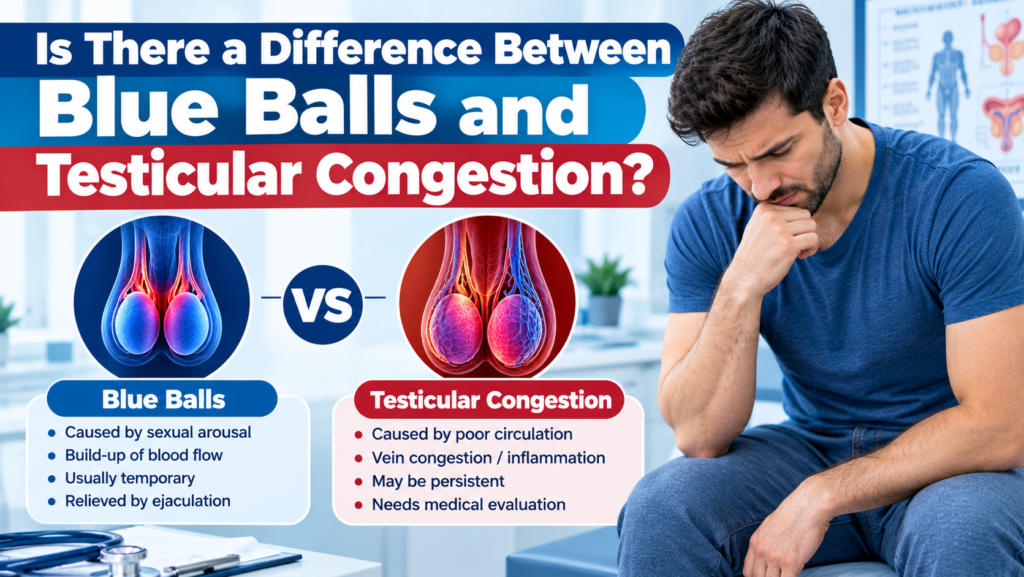
The term ‘testicular congestion’ is occasionally used in connection with the feeling experienced in blue balls. However, such wording might indicate a physical process which has not necessarily been identified as a cause in each case.
There are unique anatomical roles played by the testicles, epididymis, scrotum tissues, and other parts. The pain felt in this area may be caused by various structures, and there are different potential causes behind it.
While one male patient experiences heaviness/pressure after long arousal periods, he might be suffering from the typical condition known as blue balls. Meanwhile, another man who has similar pains might have a different condition altogether.
The place of pain, the situation when it is felt, its intensity, as well as any other symptoms are relevant to consider.
In view of this, terms like congestion or epididymal hypertension must not be used instead of proper medical thinking.
Where symptoms are either unusual or recurring, an individual evaluation is more effective than trying to understand the reason from the terminology used.
Blue Balls vs. Epididymitis: An Important Medical Distinction
When it comes to addressing issues regarding testicular pain, one of the primary things to be considered is differentiating between arousal-induced discomfort from epididymitis.
Epididymitis refers to inflammation of the epididymis, which could occur due to infections or any other causes. The symptoms include pain, tenderness, and swelling of the testicles or scrotum and even urinary symptoms or fever.
Blue balls, on the other hand, refer to temporary discomfort caused by sexual arousal without orgasm.
The two scenarios cannot be used interchangeably.
For a male patient who complains of pain, swelling, fever, burning sensation during urination, and any form of discharge, he should see his doctor. Sudden and sharp pain in the testicles is an emergency situation as testicular torsion has to be ruled out.
It is not prudent to conclude that if one is having pain in the testicle, it will heal itself through ejaculation.
Testicular Torsion: When Pain Is an Emergency
Torsion of the testicle happens when the spermatic cord gets twisted thereby compromising the blood flow to the testicle.
Symptoms may include:
- Sudden and sharp pain in one testicle.
- Swelling of the scrotum.
- Nausea or vomiting.
- Abdominal or groin pain.
- An elevated testicle or one situated at an uncommon angle.
These symptoms may not affect everyone, and their absence does not rule out torsion.
When a suspicion of testicular torsion is present, urgent medical attention is recommended. One should not attempt to wait for a relief of the discomfort through ejaculation, resting, taking a shower, or other home remedies.
Urgency is necessary to save the testicle from harm.
That is the reason why educating people about the condition of blue balls has to involve a specific warning about one of its symptoms: testicular pain.
When Should a Man Consult a Healthcare Professional?
Although some discomfort associated with arousal may go away on its own, professional evaluation becomes necessary in case these symptoms do not follow the predicted temporary course.
Immediate medical attention should be sought for:
- Acute or intense testicular pain.
- Pain associated with nausea and vomiting.
- Swelling of the scrotum.
- Blue, dark, or any kind of abnormal color on the skin of the testicles.
- Intense pain following an injury.
- Pain that might suggest the possibility of testicular torsion.
Consult your physician if you experience pain, have a new lump, feel tender, experience difficulty in urination, have a fever, or experience any symptoms that are not due to sexual activity.
Healthcare providers can perform medical history and physical examination and refer you for further tests such as urine studies and ultrasounds as needed.
The type of diagnostic procedure used depends on the clinical findings. Not all cases need all tests.
However, it should be noted especially that one should refrain from using the blue balls term to brush aside symptoms which have not yet been clinically evaluated.
How Is Blue Balls Diagnosed?
There is no lab test to confirm the clinically reported blue balls condition.
When a man complains about genital pain following sexual arousal, a doctor can start with the question:
- When did the pain begin?
- Was it initiated while in the state of sexual arousal or afterwards?
- Is it unilateral or bilateral pain?
- What is the intensity of the pain?
- What is its duration?
- Does it decrease after the arousal decreases?
- Does there appear to be any swelling, discoloration, fever, nausea, or urinary discomfort?
- Has this happened before to this person?
These inquiries will determine if the symptoms align with the common symptoms of transient arousal discomfort or something else.
Further tests can be required if the symptoms are unclear or worrisome.
The correct diagnosis must be made according to the patient’s overall condition and not by the common name used by the patient.
Can Blue Balls Be Prevented?
There is no foolproof way to prevent blue balls because, among other reasons, the condition is not completely understood and it does not affect everyone.
However, there are some steps that could be taken to minimize confusion and anxiety.
Firstly, understand how a healthy body works. Awareness of the fact that sexual arousal need not always culminate in orgasm will help avoid fear and apprehension.
Secondly, communicate clearly. Couples can talk about their expectations and boundaries in bed without feeling compelled to have sex.
Thirdly, do not put pressure on yourself to perform.
Do not violate personal boundaries. Sexual intercourse can be stopped by anyone at anytime. Let disappointment not translate into pressure or guilt.
Visit a medical specialist if there are recurrent symptoms. The frequent presence of discomfort can allow a medical professional to decide if further action needs to be taken.
The aim is not to erase all differences in male sexual response. The goal is simply to ensure proper physical health and sound relationships.
Common Myths About Blue Balls
The table below lists several myths that hinder proper knowledge of male sexual health.
Common myth | Medical clarification |
Blue balls is when your testicles go blue. | The term is colloquial; actual discoloration is not an expected feature and warrants assessment. |
Everyone gets blue balls but no ejaculation. | Not everyone will feel any pain from it. |
Sperm becomes dangerously trapped. | The unused sperm cells will die off and be absorbed. |
Ejaculation is medically compulsory. | Arousal can end on its own without ejaculation. |
Blue balls causes infertility. | It is not a well-known reason behind infertility. |
Blue balls show that a guy is very healthy in terms of testosterone. | It doesn’t mean that his testosterone level is abnormal. |
He needs help from his partner to relieve himself. | There is no medical basis of forcing someone. |
All cases of testicular pain are blue balls. | The condition can have several causes, some of which can be emergencies. |
Blue balls and erectile dysfunction are the same thing. | They are two different issues that have their own meanings and causes. |
Sexual supplements are needed to alleviate it. | There is no proven need for any supplements to address arousal-induced pain. |
Good sexual health education needs to dispel these myths without overstating either the risks or the advantages of any particular treatment.
The Role of Clinical Sex Education in Male Sexual Health
Sex education provides an individual with information on the link between anatomy, physiology, psychology, communication, and sex.
The majority of the community perceives the issues of male sexuality as the issues related to the sexual performance, fertility, and erectile capacity of the male member. Therefore, there is very little knowledge on what is considered as normal responses to sex and when a person is facing some medical conditions.
There are several aspects of education.
Anatomical knowledge
First of all, knowing how the testicles, epididymis, penis, and other reproductive organs function allows for better understanding of the body symptoms.
Sexual physiology
Secondly, knowledge about such terms as arousal, erection, orgasm, ejaculation, and sperm production eliminates myths on how our bodies work.
Psychological understanding
Anxiety, expectation, embarrassment, and even misinformation may affect the way people react to their sexual experiences. Proper education can assist in differentiating between symptoms and meanings people associate with them.
Relationship communication
Education on sexual health should emphasize respect for communication, consent, and boundaries rather than any kind of coercion or implying any obligation in sexual activities.
Medical awareness
One should know whether symptoms should be monitored in a conservative way or whether it is necessary to consult a doctor.
Ethical responsibility
Providing sexual health information, professionals should avoid making unfounded statements, promoting miracle drugs, prescribing unnecessary medicines, and promising great sexual performance.
The following principles may be considered by healthcare professionals, students, counselors, teachers, and adults in need of sexual health information.
A Clinical and Educational Perspective on Male Sexual Health

In all my work in my professional and educational career, accurate information is a key element when talking about sexual health issues.
For instance, men may avoid getting help due to being embarrassed or thinking that their problem may be considered a sign of poor sexual performance. Others can believe unverified online recommendations or products for solving all male sexual problems.
It is important for the education to avoid going into extremes: ignoring the problem and considering normal physiology as some kind of dangerous disease.
In regard to blue balls, it is necessary to answer several basic questions.
Is the discomfort temporary and not severe? Does it appear only after sexual arousal? Does it go away as arousal diminishes? Are there some signs of other medical problems?
This list helps one to approach the problem in the right way, however, it cannot take the place of the clinical examination, where necessary.
At the same time, one should remember about psychological and interpersonal damage caused by misleading. One should use the medical information to educate people about their bodies and decisions, but not to humiliate, blackmail a partner or suggest quack treatment methods.
One should approach the problems of sexual health scientifically, professionally, respectfully and communicatively.
Frequently Asked Questions About Blue Balls
What exactly are blue balls in men?
“Blue balls” are an informal name for a condition characterized by temporary testicle or genital pain after sexual arousal without ejaculation. This state can be characterized by pain, aching, heaviness, throbbing or squeezing feeling.
Is blue balls a real medical condition?
The experience described by people exists and is known, however, “blue balls” are not considered a distinct and established disease. The term epididymal hypertension is mostly used, but the exact nature of this condition is not yet known.
Can blue balls cause permanent testicular damage?
A temporary experience, however, is not known to lead to any harm. Nonetheless, one shouldn’t dismiss painful symptoms as blue balls.
Do men have to ejaculate to relieve blue balls?
No. Ejaculation might alleviate some people from pain, but it isn’t a must-do from the medical perspective. Arousal could simply subside by itself.
Can blue balls cause infertility?
The link between temporary arousal discomfort and infertility has not been proven yet. Reproductive system complications should be diagnosed separately.
How long does blue balls last?
It usually fades away within several minutes, since arousal subsides, although people may experience this differently. Prolonged pain needs medical consultation rather than waiting for a period of time.
Can a man get blue balls without having sexual intercourse?
Yes. Pain may develop after experiencing sexual arousal without engaging in sexual intercourse.
Does blue balls indicate erectile dysfunction?
No. Blue balls and erectile dysfunction are two different problems. The first problem involves a temporary condition with regards to being aroused while the latter is a condition that involves inability to have an erection or maintain one.
Should a man take medication for blue balls?
There is no prescription medicine that everybody should take in order to solve the problem. Mild conditions do not require any medications at all. Taking medications without proper advice with regards to the reason behind the pain should be avoided.
When is testicular pain an emergency?
Emergency assessment should be sought if there is sudden or intense pain especially when there is swelling, vomiting, nausea or any other problem with regards to the testicles.
Can blue balls justify pressuring a sexual partner?
No. Temporary pain does not give the right to engage in sexual activities with the other individual. Sexual engagement should not compromise the rights of the other individual.
Can blue balls happen to married men?
Yes. Getting married does not make an individual exempt from experiencing these things.
Learn More Through IMAHRKMI's Sexual Health Education Programs
Knowledge of male sexual health is more than knowing what the symptoms are called. It is about understanding the anatomy of reproduction, sexual physiology, psychology, communication, relationships, and limitations of medical information.
The International Medical Allied Health Research Knowledge and Management Institute (IMAHRKMI) offers various educational materials and training programs on subjects such as clinical sexual education, human behavior and psychology, and professional growth.
The following are resources for those interested in the above topics.
Clinical Sex Education Course
Explore the online clinic of IMAHRKMI to learn about human sexuality and sexual health, among other topics in medicine and psychology.
Investigate the Clinical Sex Education Program
Dark Psychology Online Certificate Program
Study topics on psychological influence, manipulation, persuasion, psychological boundary, and psychological protection in an educational and ethical manner.
Explore Dark Psychology Program
Guidance on How to Join IMAHRKMI Dark Psychology Program on YouTube
Refer to the official YouTube guidance video to know about how to join the course.
IMAHRKMI Course Enrollment Guide Video
Official YouTube Channel of IMAHRKMI
Check Out the Complete List of Online Courses
Those who wish to pursue other educational courses may refer to the available courses.
Browse IMAHRKMI Online Courses
Educational Disclaimer: The information regarding courses and enrollment is provided by IMAHRKMI. Potential learners are encouraged to look at the current syllabus, eligibility criteria, costs, and certifications before enrolling in any course. Educational courses are not a substitute for professional medical education or treatment.
Conclusion: Accurate Information Is Essential for Male Sexual Health
Blue balls can be defined as a colloquialism to describe a form of temporary discomfort that some males feel after sexual arousal without orgasm. While the discomfort can be painful, it typically lasts temporarily and is not known to cause any testicular problems or fertility.
Knowledge of the science of sexual arousal helps dispel a number of myths. There is no sperm build up that necessitates medical necessity until ejaculation. Also, sexual arousal does not need to result in orgasm.
One of the possible ways to deal with the discomfort is waiting for it to disappear, focusing the mind on something else and doing something comfortable. One might find relief in ejaculation, but it is not a must.
The primary concern would be recognizing when symptoms can signify other conditions. Severe and sudden pain, swelling, changes in color or continuous pain without explanation should be checked by the doctor.
Another equally important issue is the moral side of sexual health education. It is unethical to use the idea of blue balls to put pressure on the sexual partner and force him or her into sexual intercourse.
With appropriate education, men can gain more knowledge regarding their reproductive health issues and make intelligent choices.
With medical education, there will be less fear, elimination of misinformation, and better choices rather than fear and intimidation.
References and Further Reading
- Cleveland Clinic. Are “Blue Balls” Real? Causes, Symptoms, and Relief.
Read the Cleveland Clinic article
- IMAHRKMI. Clinical Sex Education Course.
- IMAHRKMI. Dark Psychology Online Certificate Program: Awareness, Influence, Manipulation and Psychological Protection.
- IMAHRKMI. Online Short Courses.
This article is for general health information purposes only. It does not constitute a professional health care diagnosis or treatment recommendation.